
Introduction
Imagine slipping on a VR headset and entering a world that not only responds to your movements, but adapts intelligently to your style of play, remembers your choices, and evolves with you. In these immersive worlds created by Artificial Intelligence (AI) and Machine Learning (ML), gaming isn’t just about pressing buttons—it’s about living another dimension. But as these technologies power a new generation of virtual-reality (VR) games, they also bring unintended consequences. This is the double-edged future of VR gaming: exhilarating potential and hidden perils.
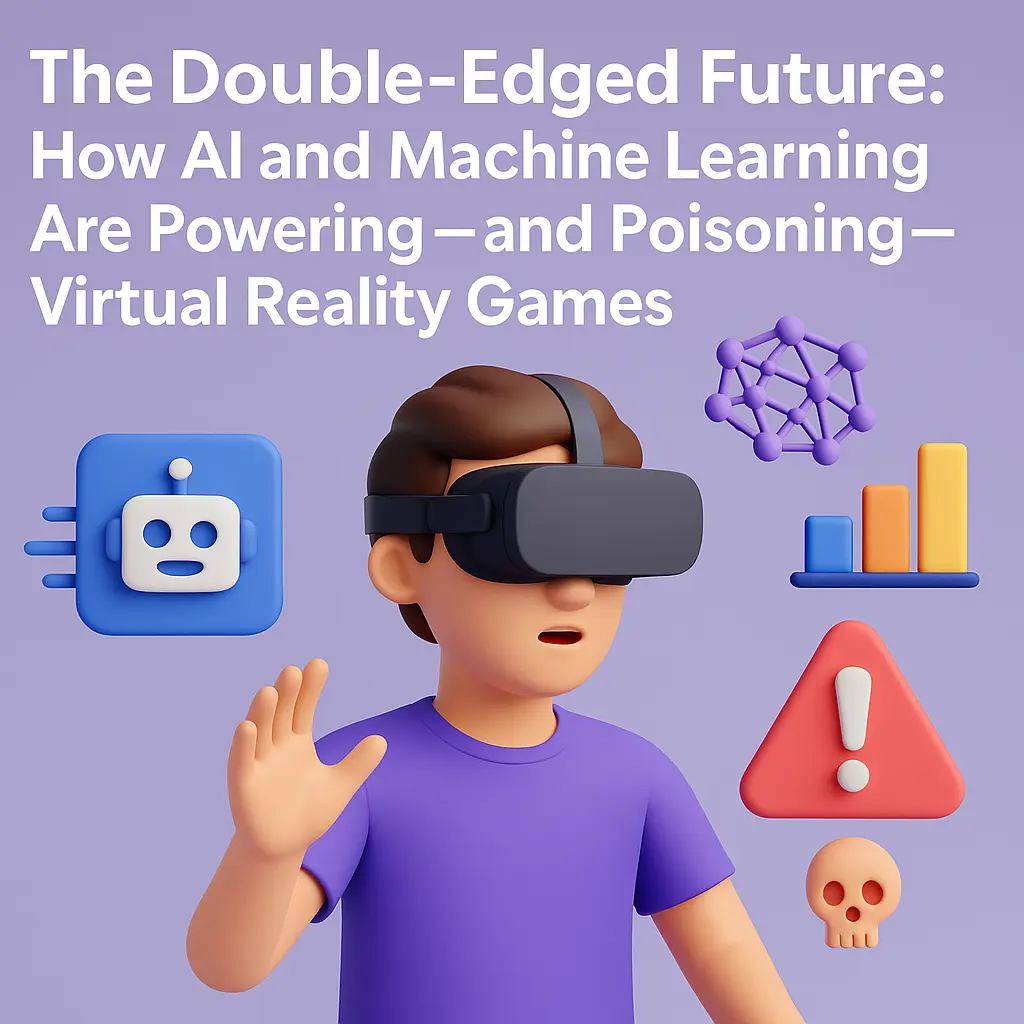
In this article, we’ll explore how AI/ML are fueling next-gen VR experiences, the awesome power they unlock, and the negative side-effects that already deserve attention. Whether you’re a developer, gamer, or just curious about where tech is headed—this journey through VR’s bright promise and dark risk will give you a meaningful perspective.
Power: The Bright Promise of AI/ML in VR Games
1. Immersive, adaptive worlds
VR games powered by AI and ML are breaking free of static environments. Algorithms can generate procedural worlds, adapt difficulty in real-time, and respond to players’ patterns. As one article notes: “AI algorithms can analyse player behavior and adapt the game world accordingly. This means … each playthrough feels unique.”
Such responsiveness boosts replayability, personalization and player engagement. NPCs (non-player characters) aren’t just scripted—they can learn, remember, evolve. This heightens the sense of presence and immersion.
2. Smarter interactions and story
With ML models, VR games can deliver branching narratives, dynamic dialogues, and emotional resonance. AI can tailor storytelling based on user behaviour—what you did in the last session might affect what happens next.
For example, voice-and-gesture recognition, adaptive audio/visual feedback, and context-sensitive hints can make the virtual world feel alive. One source describes how AI helps VR: “AI-driven virtual reality applications equip businesses with remote monitoring capabilities ” but those same innovations apply to gaming.
3. Market momentum & innovation
The business case is strong. A recent market report estimates that the global AI in games market (including AR/VR) is projected to grow by US $27.47 billion from 2025-2029, with a CAGR of ~42%.
This kind of momentum means more investment, more experimentation, and faster evolution of VR games. For developers and gamers alike, that means more ambitious titles, wider hardware support, and new forms of play.
4. Democratizing game creation & experience
AI/ML plus VR lowers some barriers. As tools mature, even smaller teams can build richer experiences. You don’t have to hand-craft every detail—AI can help fill content, generate assets, or adapt logic. This empowers indie developers and can lead to more diverse, creative games.
Poison: The Hidden Risks & Negative Effects
1. Technical and performance constraints
With power comes cost. VR games powered by AI/ML demand high compute: real-time environment adaptation, responsive NPCs, and immersive graphics require robust hardware, low latency, sensors, and often cloud or edge compute. According to one source: “One of the biggest is bias … the problems of processing power and power consumption.”
For players with lower-end hardware or less ideal network conditions, the experience may degrade. Latency, tracking hiccups or resource bottlenecks can ruin immersion. Also, as the market report warns: “network latency in between games poses a challenge.”
2. Over-personalization, addiction, and unintended consequences
When games adapt to you, they can also exploit you. Adaptive difficulty, personalized loops and reward structures can enhance engagement—but also edge toward addiction, especially if the design is manipulative. A game that knows your patterns can keep you just enough challenged, just enough rewarded. Over time this can blur into unhealthy territory.
Moreover, hyper-realistic worlds may amplify escapism. If a VR game powered by AI becomes more compelling than real life, it raises questions about balance, social consequences, and mental health.
3. Ethical issues: bias, privacy, control
AI/ML systems are only as good as their data and design. According to research: “Any AI tool has the potential to show bias based on the big data sets used to train it, accents that are outside of [the typical group] often perform poorly.”
In VR games this could mean NPC behaviours that favour certain profiles, accessibility issues, or unintended exclusion. Also, immersive VR systems collect deep biometric data (eye tracking, motion, voice). That raises privacy risks and potential misuse of that data. For example, ML models have been used to infer VR user activity from network traffic with high accuracy.
4. Lack of transparency and the “black box” problem
AI/ML systems inside VR often evolve dynamically, and players may not understand why the game behaves a certain way. This opacity can reduce trust. In sensitive applications (e.g., VR therapy, education) this could be a serious issue. Research on “cybersickness detection” in VR using ML highlights the need for explainable AI in immersive systems.
5. Over-reliance and creative stagnation
If developers lean too heavily on AI/ML to generate content, games may start to feel formulaic or lack human artistry. Similarly, players may expect hyper-adaptive experiences everywhere, raising the bar and making simpler games feel outdated. There’s also the fear that AI might limit experimentation if everyone uses the same tools and models.
Balancing the Scale: Best Practices for Developers & Gamers
For Developers
Design for transparency & fairness. Make your adaptive systems understandable to players. Monitor bias, accessibility, and ensure diverse data/training sets.
Keep performance and latency in check. Optimize for the hardware base your audience uses. VR is unforgiving if performance dips.
Plan for modularity and fallback. If your AI/ML system fails or misbehaves, have safe modes or non-adaptive back-ups.
Respect privacy and data. Collect only the data you need, anonymize it, and be clear about how it’s used. Especially important in VR where biometric data may be involved.
Blend human and AI creativity. Use AI to assist—not replace—human designers for narrative, art, emotion. Strive for hybrid approaches.
For Gamers & Players
Be aware of adaptive systems. Know that some games change based on your behaviour—stay mindful of how that affects your play habits and time investment.
Balance VR play with real life. Immersive, intelligent games are compelling—but real-world connection and healthy routines remain important.
Check hardware requirements. For the best experience, ensure your system and internet connection can keep up; performance drops degrade the magic.
Review privacy policies. Especially for VR games that capture motion, voice, eyes—know what data is captured and how it’s used.
Seek variety. Don’t rely solely on hyper-adaptive games; mix in experiences that are simple, creative, or more social.
FAQs (Frequently Asked Questions)
Q1: Are AI/ML truly required for VR games?
Not always. Many great VR games use traditional scripting and design. AI/ML add depth, adaptation and scale—but building a strong core experience still matters. Use the right tool for the right job.
Q2: Will VR become the dominant gaming platform thanks to AI/ML?
It’s not guaranteed. While AI/ML enhance VR, there are still hardware cost, user adoption and accessibility challenges. The combination looks promising, but dominance depends on ecosystem growth, affordability and content quality.
Q3: Can AI/ML make VR games unsafe or harmful?
There is risk. If a VR game collects biometric data, adapts too aggressively, or uses manipulative design, it can impact privacy, mental health or fairness. Responsible design and awareness are key.
Q4: How soon will “smart” VR games—fully adaptive, AI-driven—be mainstream?
We’re already seeing early versions. Market reports show rapid growth in AI+VR. Within a few years (3-5) adaptive and intelligent VR experiences will become much more common.
Q5: What’s the difference between AI, ML and VR in this context?
VR (Virtual Reality): A technology that immerses the user in a computer-generated environment.
AI (Artificial Intelligence): Broad set of techniques that allow machines to perform tasks that usually require human intelligence.
ML (Machine Learning): A subset of AI that uses data to learn patterns and improve performance.
In VR games, VR provides the immersive platform, ML can learn from player data, and AI uses that learning to adapt gameplay, narrative or environments.
Final Thoughts
The fusion of AI, ML and VR is redefining what games can be. On the one hand, we’re witnessing immersive worlds that adapt to us, evolve with us, and feel more alive than ever. On the other hand, these same tools carry risks: performance demands, privacy concerns, ethical issues and the possibility of over-reliance on algorithmic systems.
For developers, the mission is to harness the power of these technologies while guarding against the poison they can bring. For players and enthusiasts, it’s a call to enjoy the magic but stay aware of the edge. The future of VR gaming is not simply about bigger graphics or smarter bots—it’s about meaningful, intelligent, human-centred design.
When you next put on a VR headset, remember: you’re entering a world powered by algorithms and code—but also human creativity and responsibility. Let’s enjoy this double-edged future together.
External Links & References
CAVENDISH –The Role of AI in Enhancing Virtual Reality Gaming
Codewave–AI/VR Development: How AI is Transforming Virtual Gaming
Appinventive – How AI is Transforming Virtual Reality
The idea of VR worlds evolving with player choices is really interesting – it sounds like ML is key to making that seamless. I found some related discussion on https://seed3d.ai about the challenges of implementing dynamic environments.
In case you’re exploring your style through seasonal color analysis, tools like Color Analysis Pro or numerous free online quizzes can be a great start to understanding your distinctive palette. For example, if you’re eager to know whether you belong to the deep summer color season, learning about the deep summer palette—known for its chilly, muted, and soft hues—can truly help in choosing clothing and makeup that enhance your natural features.
If you want a more reliable assessment, AI color analysis apps offer personalized insights by scanning your skin tone, including common options for yellow skin tone colors to wear or even distinct palettes like soft autumn and light summer. For those unsure how to cancel Color Analysis Pro or navigate its features, instructions and community tips are regularly shared on forums and authorized sites what hair color suits me ai . This way, you can discover seasonal colors, hair color trends for 2026, and even virtual hair color try-ons without complications.